
Headless Talent Intelligence

The future of the function is a governed core that serves every screen, not a team that owns the report and not an organisation left to free-range on ungoverned AI.
Talent intelligence has spent the best part of a decade evolving in exactly the way a young discipline should. We debated whether the function should sit as a fat centre of excellence or as a small central team with capability embedded across the business, and that was the right debate to have. Each model was a sensible response to the tools we had at the time. When the data was locked inside a handful of expensive platforms and every insight had to be hand-built by a specialist, the only real question was where to put the specialists. We have not been getting it wrong. We have been reacting and adapting about as fast as the function would allow. What has changed is not our judgement. It is the tooling, and it has now moved far enough that the old trade-off no longer has to bind us.
Here is the reality in most people functions today. Anyone, in any team, can open a large language model and generate a confident, polished, entirely plausible piece of talent insight in about thirty seconds. A competitor headcount estimate. A skills forecast. A market briefing. A build versus buy recommendation. It looks authoritative. It carries the sheen of analytical rigour. And a good deal of the time it is wrong in ways that nobody in the room is equipped to catch. This is happening now, whether or not your function has a view on it. The genie is not going back in the bottle.
So the question is no longer central versus embedded. The question is whether the intelligence your organisation runs on is governed or ungoverned. And the answer, the architecture that lets you have both control and reach at the same time, comes from an unlikely place: the way modern software is built.
What headless actually means
In software, a system is called headless when the back end is separated from the front end. In a traditional, monolithic build, the data, the business logic and the presentation layer are fused into a single stack. The cleanest example is old-school web content management, where the content and the template that displayed it lived in the same system. That meant the content could only ever become one thing: that one website. If you wanted the same content on a mobile app, a kiosk, a watch or a partner’s site, you rebuilt it each time.
Headless architecture strips off the presentation layer, the head, and keeps the content and the logic underneath. Everything is then exposed through a well-documented interface, an API, so any number of front ends can request the same governed content and render it however they need. The principle is simple and powerful: manage the thing once, deliver it anywhere. The source of truth and the point of consumption are no longer the same object. You can add a new screen, a new channel, a new device, without touching the core.
That single idea, separating the source of truth from the point of consumption, is the most useful thing talent intelligence can borrow right now.
Talent intelligence is monolithic, and it hurts
Think about how intelligence actually reaches people in your organisation today. The labour market insight lives inside a vendor’s interface. The internal attrition metric lives in a dashboard. The competitor view lives in a screen you have to log into. The bespoke benchmark lives in a slide that one analyst built last quarter and that nobody else can reproduce. Every tool is its own head, bolted directly onto its own data, defining skills and roles and markets in its own way.
This is the monolithic trap, and it produces exactly two failure modes, both of which I have written about before without naming the cause.
The first is the bottleneck. Because the intelligence is trapped inside the tools, getting an answer means going to the team that owns the tools. The central function becomes a queue. This is the fear that drives every “let’s embed the capability” reorganisation.
The second is worse, and it is the one accelerating right now. The obvious escape from the bottleneck is to let people serve themselves. Give the recruiters a data platform. Give the business partners a model. Tell everyone to use the AI tools. And so the interpretation of data, the part that used to require a labour economist or a trained analyst, gets handed to people who were never trained to do it, using tools that make the gap between their expertise and the task almost invisible. That is the plausible defensibility problem. The output looks defensible. The methodology is absent. And free-rein use of ungoverned LLMs is pouring petrol on it.
Notice that both failure modes come from the same root. The intelligence and the interface are the same object. Fix that, and both problems dissolve.
The headless model for talent intelligence
Picture it as three layers.
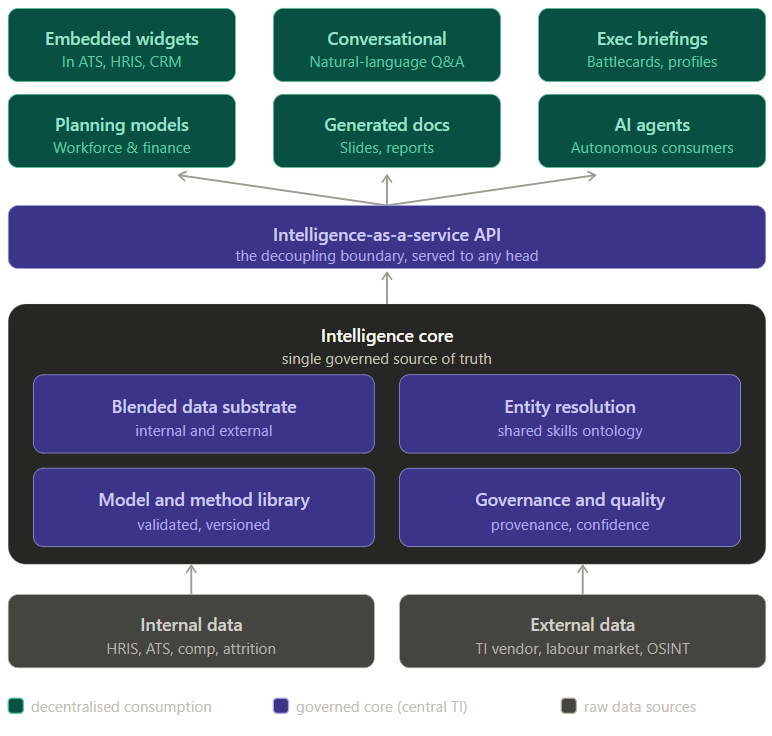
At the foundation sits the intelligence core, and this is the part the central team owns outright. It is the single governed source of truth, and it does the work that no individual screen should ever do for itself. It blends internal data, your HRIS, ATS, compensation, performance and attrition signals, with external data, the labour market feeds, competitor and open-source signals, and compensation benchmarks. It resolves all of that against a shared ontology, a common language of skills, roles, geographies and companies, so internal and external data can actually speak to each other. It holds the validated, versioned models and methods. And, above all, it carries the governance: provenance, confidence, freshness, validation against real outcomes. The core never renders anything. It does not produce reports. It produces governed intelligence.
In the middle sits the contract, the API, the intelligence-as-a-service layer. This is the membrane that makes the whole thing headless. It exposes the core through consistent, documented endpoints so the same question returns the same governed answer regardless of who, or what, is asking. Increasingly this is not just feeding dashboards but serving the AI agents that are about to become heavy consumers of talent data in their own right.
At the top sit the heads, and here is where the function finally gets its reach. A head is any surface where a human or a system consumes the intelligence: an embedded widget inside the ATS where a recruiter already works, a conversational interface that answers a question in plain language, an executive battlecard, a workforce planning model, an auto-generated briefing, an autonomous agent. The heads can multiply endlessly. The same governed intelligence renders consistently across all of them, and building a new one costs you an integration, not a rebuild.
Control and empowerment, at the same time
This is the part that matters, and it is why people teams should be moving towards this on purpose rather than waiting to see how the AI question resolves itself.
The old debate forced a false choice. Centralise and you get control but you become the bottleneck. Embed or democratise and you get reach but you lose the quality. Headless refuses the trade. You centralise the thing that must be governed, which is the interpretation, the methodology, the data blending, the truth. You decentralise the thing that should be free, which is the consumption. A recruiter, a business partner, a hiring manager or a chief people officer can pull intelligence into whatever surface suits them, and what they pull is already governed. Provenance and confidence travel with the answer through the contract. They are consuming a validated result, not raw data they are about to misread.
That is the difference between democratising data and democratising interpretation, and it is everything. Spreading access is good. Spreading the act of interpretation to untrained people armed with confident AI tools is how organisations end up making expensive decisions on fiction. Headless lets you do the first while quietly protecting the second.
So the headless core is not a way of locking AI down. It is the opposite. It is how you say yes to the energy your people clearly want, the natural-language querying, the instant briefings, the agents, while making sure that what flows through all of it is intelligence you can stand behind. You are not policing free-rein LLM usage after the fact. You are giving people something better to reach for, and you are governing it at the source.
How you actually build the Nexus
For anyone who has followed this thread, this is the architecture that finally makes the Talent Nexus real. The Nexus was always the vision, an omniscient layer that fused internal and external data ## Headless by design, with a core team that matters more, not less
There is a lazy reading of all this, and it is worth killing before it spreads. Headless is not a way to shrink the team or hand the function to the machines. It is the opposite. Going headless by design is what lets a specialist team stop being a report queue and start doing the work that actually needs them.
Be clear about what moves and what stays. The routine, repeatable output, the standard briefing, the on-demand market view, the first-pass battlecard, moves to the heads, where people and agents serve themselves from governed intelligence. That commodity work was never a good use of a labour economist’s time, and pretending otherwise is how the bottleneck formed in the first place.
What stays, and what the function should be unapologetic about, is a core team of genuine subject matter experts, because the core does not run itself. Someone has to engineer the blended data, reconciling messy internal systems with external feeds. Someone has to validate it and own the quality and the controls, deciding what is trustworthy enough to flow through the contract and what is not. And as the heads increasingly become autonomous agents rather than dashboards, someone has to manage those agents, set their guardrails, and watch what they do with the data. That is senior, specialist, deeply technical work, and it is the spine of the whole model.
Then there is the second job, and it is the one that should reassure anyone worried that headless commoditises the craft. No self-service head, however well governed, replaces a real expert on the hard questions. When the stakes are high, the data conflicts, the answer is genuinely ambiguous, or the organisation is about to make an expensive and irreversible decision, you do not want a generated briefing. You want a talent intelligence professional in the room doing proper consulting: interrogating the assumptions, weighing the conflicting evidence, bringing the judgement and context that no model holds. Headless does not remove that person. It frees them from churning out the routine so they have the time and the standing to do the deep dives that matter.
So the shift is not from expert to platform. It is from a team that hand-makes every artefact to a team that owns and governs the core, manages the agents that run on it, and reserves its expertise for the questions that genuinely need a human. That is a more valuable function, not a smaller one.
The choice in front of people leaders is therefore not whether to keep their experts. It is whether to give those experts the architecture that lets them govern the intelligence their organisation is already consuming, before that organisation decides the ungoverned thirty-second answer is good enough.